
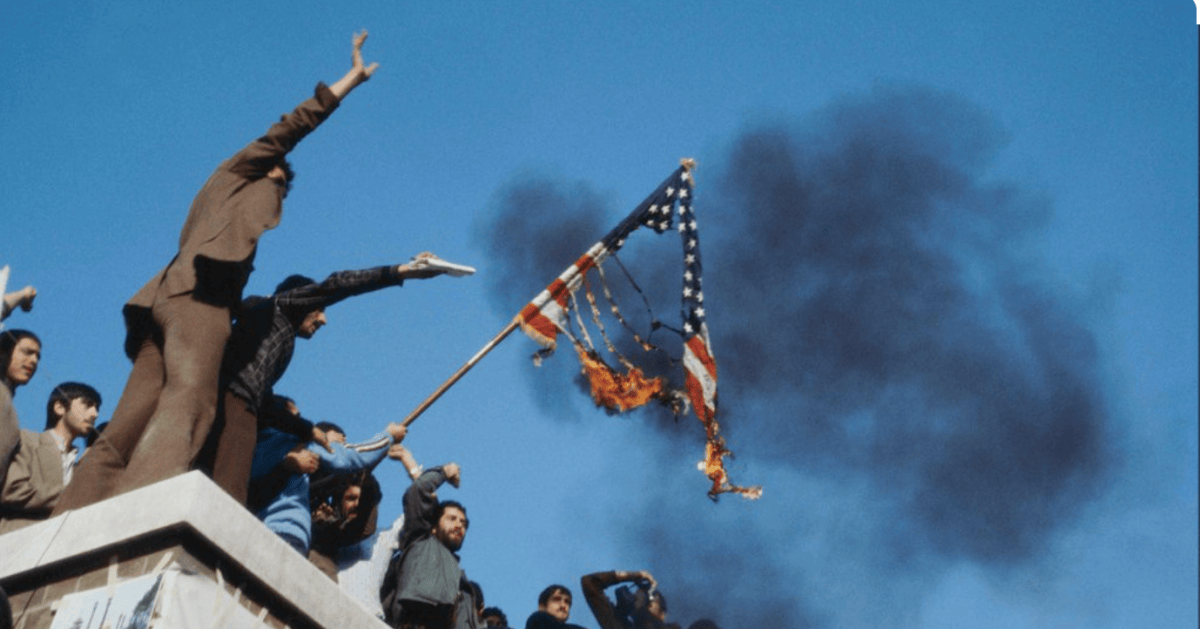
The real scandal is not that the United States acted, but that so many pretend the Islamic Republic never forced this reckoning.
By Michael L. Weiss
For the past several days, I have watched cable news with growing disbelief. Not because disagreement is inappropriate in a republic far from it. Serious democracies should argue, especially before, during, and after war. What has disturbed me is something else: the extent to which the message itself has become corrupted.
We are told the United States had no right to act. We are told the war with Iran is wrong. We are told we should have given the regime more time. More time for what? More time to rebuild its capabilities? More time to reposition its proxies? More time to refine the machinery of terror, intimidation, nuclear ambition, and revolutionary aggression that has defined the Islamic Republic since 1979?
History does not remember civilizations kindly when they confuse delay with wisdom.
The reason a state goes to war—its casus belli—matters. It always has. Wars grounded in a clear and compelling justification tend to command greater public confidence and greater strategic endurance. Those launched under muddled rationales tend to drift, divide, and decay. That is why the case for confronting Iran must be stated with moral seriousness and historical honesty.
And it begins with one simple truth: this war did not begin with American aircraft. It began with the Iranian Revolution.
The Islamic Republic declared war on the United States when it seized our embassy in Tehran and held 52 Americans hostage for 444 days. It declared war on us in Lebanon, where Americans were kidnapped, tortured, and murdered. It declared war through the bombing of the Marine barracks in Beirut and the attack on our embassy there. It declared war through proxies in Iraq, through militias across the region, through drone and rocket attacks on American positions, ships, and personnel. And it has declared war through doctrine itself—through decades of “Death to America” not as empty theater, but as governing creed. The current conflict did not emerge from nowhere; it grew out of a long record of Iranian violence against U.S. forces, interests, and allies.
Yet one would never know this from much of the commentary now dominating television panels and op-ed pages. There, America is cast as the reckless escalator and Iran as the aggrieved party denied one more chance at reason.
That is not analysis. That is strategic amnesia.
The critics generally make three arguments. First, they say Iran, however vile, never posed a truly imminent threat to the United States. Second, they say this war is strategically reckless—draining our arsenals, distracting us from Russia and China, and destabilizing the Middle East. Third, they insist the war is either unconstitutional, illegal, or both.
These arguments may sound sophisticated when wrapped in the language of caution. But once examined seriously, they collapse.
Start with the claim that Iran did not constitute an imminent danger. This is the comforting illusion by which free societies often talk themselves into passivity. A threat need not already be detonating over an American city to qualify as real. Statesmanship consists in recognizing gathering danger before it becomes irreversible. Churchill understood this in the 1930s when far too many in Britain preferred procedural calm to strategic clarity.
Indeed, North Korea is not the excuse for inaction that critics imagine. It is the warning. No one urges bombing Pyongyang now precisely because the world failed to stop it before it crossed the threshold. That is the point. If one wishes to avoid confronting a hostile regime after it possesses a deliverable nuclear deterrent, one must act before that point arrives, not after.
And Iran is not merely another authoritarian nuisance. North Korea’s organizing principle is survival. Iran’s has long been ideological expansion. Since the revolution, Tehran’s purpose has been larger than regime maintenance alone: to undermine Western institutions, radicalize the region, export militant theocracy, and build a sphere of coercive influence from the Levant to the Gulf and beyond. This is not a theory. It is the regime’s record.
I do not write this as an academic abstraction. I write it as someone who has spent years in and around the Middle East, who has watched regimes rise on slogans and sustain themselves on fear, who has seen what happens when faith is corrupted into ideology and governance becomes a weapon against truth. Revolutionary regimes do not moderate because we wish them to. They exploit patience. They interpret hesitation as weakness. They use negotiation as cover when negotiation no longer serves any moral or strategic end.
Those of us who have spent time in that part of the world know this pattern well. We have seen the smiling diplomat on one day and the militia funeral on the next. We have seen the Western expert insist there is still time, still room, still possibility—long after the people living under the regime understand otherwise.
The second criticism is that military action cannot achieve regime change and may instead deepen chaos. That objection mistakes certainty for wisdom. No serious strategist believes air power alone automatically topples governments. But military force does not operate in a vacuum. Sustained strikes can degrade command structures, destroy infrastructure, shatter elite confidence, interrupt logistics, and create the conditions under which internal opposition becomes possible. The objective need not be packaged as a slogan to be real.
War, as Clausewitz reminded us, is always conducted under conditions of uncertainty. That is not an argument against action. It is the permanent condition of action. The administration may well have done a better job articulating its goals at the outset—coverage across major outlets has emphasized that its rationale has often shifted and that even members of Congress are still debating the campaign’s precise scope. But imperfect public messaging does not negate the larger strategic necessity.
Nor am I persuaded by the now-fashionable claim that this war will embolden Russia and China by “stretching” American power. Adversaries study not merely inventories but will. They do not only count munitions; they assess resolve. Recent reporting suggests the campaign is already imposing real costs while also driving accelerated discussion of U.S. force posture, production, and deterrent credibility. Great powers are watching, yes. But what they are watching is whether America still possesses the capacity to act when challenged.
Then comes the most preposterous criticism of all: that action against Iran risks destabilizing the Middle East.
Iran is the destabilizing force in the Middle East.
For nearly half a century, Tehran has funded proxies, armed militias, inflamed sectarian wars, undermined Arab governments, and transformed fragile states into battlegrounds. To warn that confronting Iran might upset regional stability is to speak as though the arsonist were the fire brigade. Neutralizing the principal exporter of terror and coercion in the region does not guarantee peace, but it does open possibilities that Tehran has spent decades trying to extinguish.
There is another truth many commentators still do not wish to admit: the old assumptions about traditional alliances have already frayed. Europe’s moral confidence has not always been matched by strategic seriousness. Many Arab states, because of geography and vulnerability, adopted outward postures of caution or neutrality toward Iran. But neutrality was always more illusion than lasting settlement. Iran does not honor neutrality. It exploits it. And by making clear that even distance and caution provide no durable shield, the regime has only strengthened the logic of deeper alignment with the United States.
The final line of attack is legal. Some argue the president acted unconstitutionally by not obtaining congressional authorization. Others go further and call the campaign criminal under international law. Congress is plainly wrestling with the first question in real time, and public legal groups are advancing the second. But these are not the same argument, and they should not be lazily collapsed into one another.
The constitutional question over presidential war powers is old and unresolved. It will outlive this conflict as it has outlived many before it. But the suggestion that action against Iran is inherently illegal simply because it is preventive or because the balance of power is unequal is unserious. Under the law of armed conflict, the relevant standards are necessity, distinction, proportionality, and precaution. That debate is real, and it should be real. But “the stronger side struck first” is not itself a coherent legal argument. Public debate now reflects both that some legal scholars condemn the strikes and that others, including Natasha Hausdorff, argue they remain lawful if those core wartime principles are observed.
None of this means war is tidy. None of it means error is impossible. Recent reporting on civilian casualties underscores that war is tragic, morally dangerous terrain, and that any campaign claiming legitimacy must be judged not only by why it was launched but by how it is conducted. Serious people should say that plainly.
But the existence of danger, tragedy, and uncertainty does not erase the central fact: the Islamic Republic has been at war with the United States for decades, whether our commentators chose to acknowledge it or not.
That is the point too many in our public life refuse to confront. They speak as though America awakened one morning and, from boredom or imperial vanity, decided to pick a fight with Iran. No. Iran picked this fight forty-seven years ago. It picked it in Tehran. It picked it in Beirut. It picked it in Iraq. It picked it through terror proxies, missile development, hostage-taking, and the constant cultivation of anti-American violence as state policy.
This is not about serving Israel at America’s expense. Israel’s interest in defending itself from Iran is obvious. But it is not somehow alien to ours. It is consonant with ours. The same regime that seeks Israel’s destruction has targeted Americans, attacked American interests, undermined our allies, and worked methodically to damage the West. To separate the two as though they exist in different strategic universes is fantasy.
And here, at home, there is a lesson for us as Americans. We are free to disagree on presidents, parties, tactics, and tone. That is part of republican life. But there are moments when we must remember that we are one nation before we are competing tribes. We may come from different regions, faiths, classes, and political traditions, but we remain Americans. We are still called to stand together when confronted by regimes that openly despise liberty, faith, pluralism, and the moral architecture of the free world.
The real scandal is not that the United States acted.
The real scandal is that so many who should know better still pretend Iran had not already made itself our enemy.
In what logical universe does the United States not possess a clear casus belli against a regime that has held Americans hostage, murdered our citizens, armed our enemies, attacked our forces, threatened our allies, and devoted nearly half a century to the destruction of the order we helped build?
Not in the universe of history. Not in the universe of reason. And not in the universe of anyone who has watched this regime closely enough to understand what it is.
Iran started this war long ago.
America was right to answer.





Leave a Reply